ROG.e 2026· September 21–24 · Riocentro, Rio de Janeiro
Your engineering already solved the load. What is left is how long it lasts in the field.
Grade, thread and material come out of your drawing resolved. What decides the date of the next intervention is the coating on the part — and it reaches the end customer whole. That coating is what we have worked on since 1964.
Our team was in Rio for all four days of ROG.e, and the conversation goes on. A meeting between our sales team and your engineering or a visit to the plant in Guarulhos — and a part of yours, ours or any supplier’s, measured for coating and alloy in the laboratory.
Hydrogen embrittlement relief in a calibrated oven
01 / The argument
A coating is not a finish. It is the part’s shelf life in the field.
Where corrosion rules, the difference between one system and another is measured in hours — and it shows up years later, on the operator’s bill.
01
Specification
Load, grade, thread and material come out of the drawing resolved. It is the part the customer’s engineering does better than anyone, and it is rarely the problem.
02
Coating choice
Here the decision is usually made on part price, not on service environment. It is the only line of the specification that keeps working after delivery.
03
Field
Salt spray, immersion, thermal cycling and removal torque. The environment does not read the drawing — it reads the coating.
Outcome A
The equipment completes the planned cycle and the intervention happens on the scheduled date.
Outcome B
The shutdown picks the date, and it is never yours.
A part that comes back early from the field never comes back alone: it comes back with the name of who supplied it.
Salt-spray hours, to red rust
logarithmic scale · the era is shown alongside, not a ranking
481005001k5k10k
Zinc-nickel · Class 11993
720 h
standard requirement
Zinc-nickel + PTFERecent past
over 3,500 h
independent external laboratory
Electrodeposited zincOrigin
48–192 h
standard requirement
NanoGalv® · nanostructured zinc-nickel2025 onward
over 10,000 h from 10 µm
manufacturer data
Cadmium1926
1,000 h
ISO/IEC 17025 accredited laboratory
Zinc-nickel Class 2 · trivalent2018
≥ 1,000 h
standard requirement
Sapucaia runs its own calibrated salt-spray chamber, to ASTM B117 and NBR 8094. Some of the numbers come from an external laboratory or from the technology manufacturer — and the bar says which, one by one. Hours without thickness and without system mean nothing: see the thickness and system for each.
Chamber hours are not field years: the salt-spray test serves to compare coatings against each other, under controlled conditions, not to predict service life on the asset. Each bar carries the source of the data — accredited test, own chamber, manufacturer data or standard requirement. Sapucaia runs its own calibrated salt-spray chamber, to ASTM B117 and NBR 8094.
What does one day of downtime cost your customer?
We do not have that number — they do. And it is the best sales argument there is for your part. The math is done with the customer in the meeting, with the data from their operation; estimating from the outside would only produce a number nobody recognizes.
02 / What we apply
Four systems for oil and gas, and the standard for each.
Every process runs with the bath analyzed in-house, the coating measured by XRF and the test recorded by lot.
Flagship · exclusive licence in Brazil
NanoGalv® — nanolaminated zinc-nickel
Nanometer-scale layers alternating zinc and nickel: a defect makes corrosion travel between the layers instead of going down to the steel. It is the highest-resistance system in the portfolio.
Here the protection comes from the metal itself — at this thickness it does not depend on an organic finish on top. When the joint also needs controlled friction, what you specify is the system with a fluoropolymer over zinc-nickel, just below.
Resistance by thickness, with the source of each number.
Thickness
Salt spray
Source
5 µm
over 4,000 h
manufacturer data · ASTM B117
8 µm
over 7,300 h
manufacturer data · ASTM B117
≥ 10 µm
over 10,000 h
manufacturer data · ASTM B117
The test behind the range recorded 10,560 h in ASTM B117 — manufacturer data,
from Modumetal, the technology licensor.
ASTM B1025 · ASTM F1941 Fe/Zn-Ni 8BN · API 20E
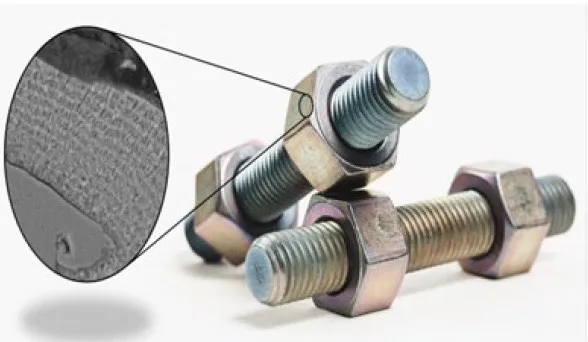
NanoGalv®: where ordinary zinc-nickel has one layer, the nanolaminate has many
Zinc-nickel ASTM B841 class 2, with a fluoropolymer finish
Alloy controlled at 12 to 16% nickel, checked by XRF on every lot, with a base of 8 to 15 µm, as the customer’s specification requires. It is the system most sold for offshore fasteners — and the finish is not there only for corrosion: it gives predictable friction, which is what makes assembly torque become clamp load and what lets you disassemble years later.
Salt spray of the complete system, with the source of each number. Base of 8 to 15 µm, as the customer’s specification requires.
Finish
Salt spray
Source
PTFE Sapucaia
over 3,500 h
independent external laboratory
Xylan® 1070 · solvent-based · 16 µm
over 3,500 h
Sapucaia technical data · ASTM B117
Xylan® 1424 · water-based · 16 µm
over 3,500 h
performance specified by Sapucaia · ASTM B117
ASTM B841 class 2 · ISO 4042 · MIL-PRF-32647
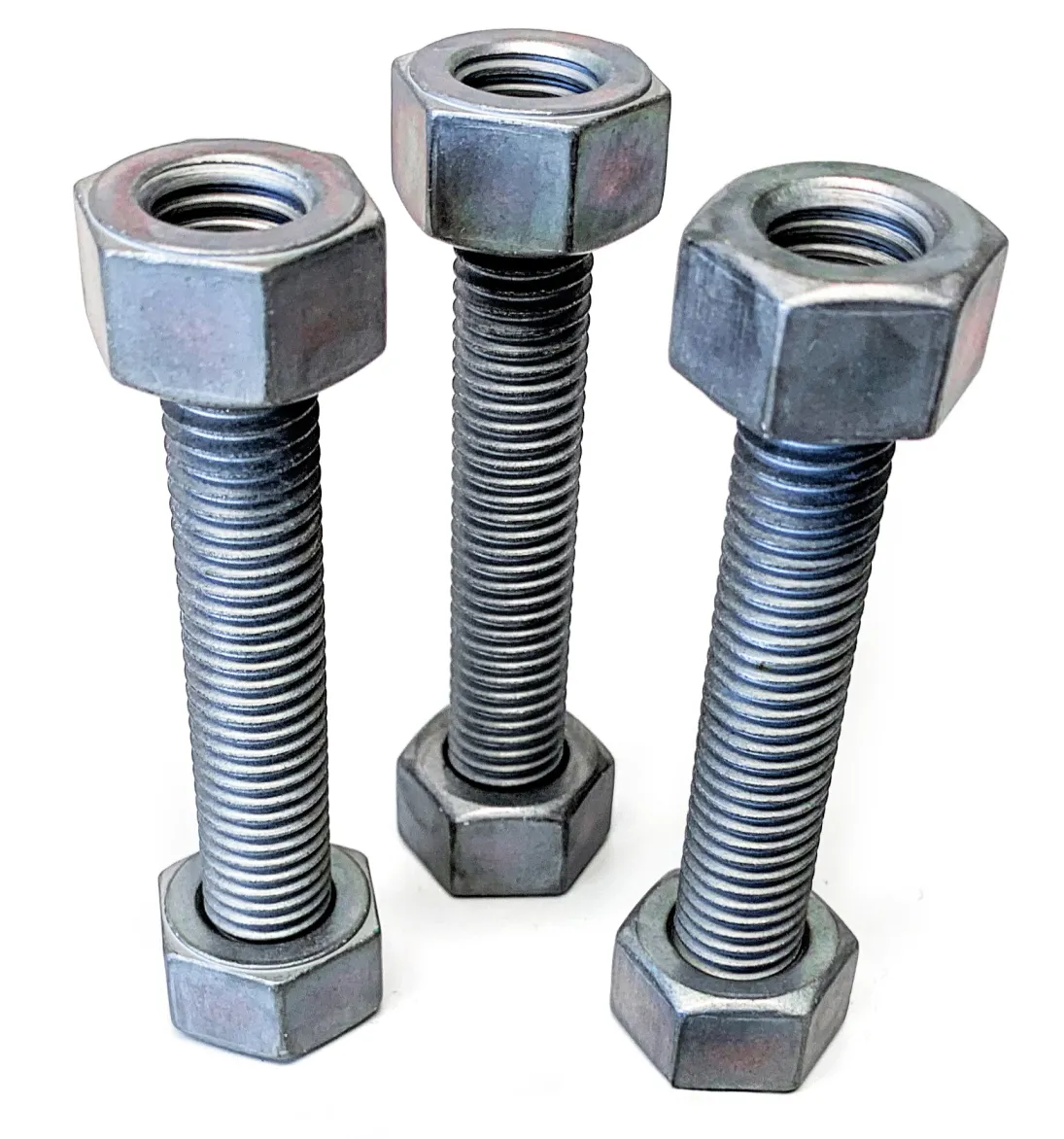
2H nut in zinc-nickel ASTM B841, the mate of the B7 stud in the flanged joint
Chemical barrier and controlled friction in the bolted joint: the predictable coefficient is what makes assembly torque become clamp load, and what lets you disassemble years later. Applying the Xylan® line requires the applicator to be approved by the manufacturer, and Sapucaia holds PPG/Whitford’s.
Oil and gas specifications that cite Xylan®: see the table below
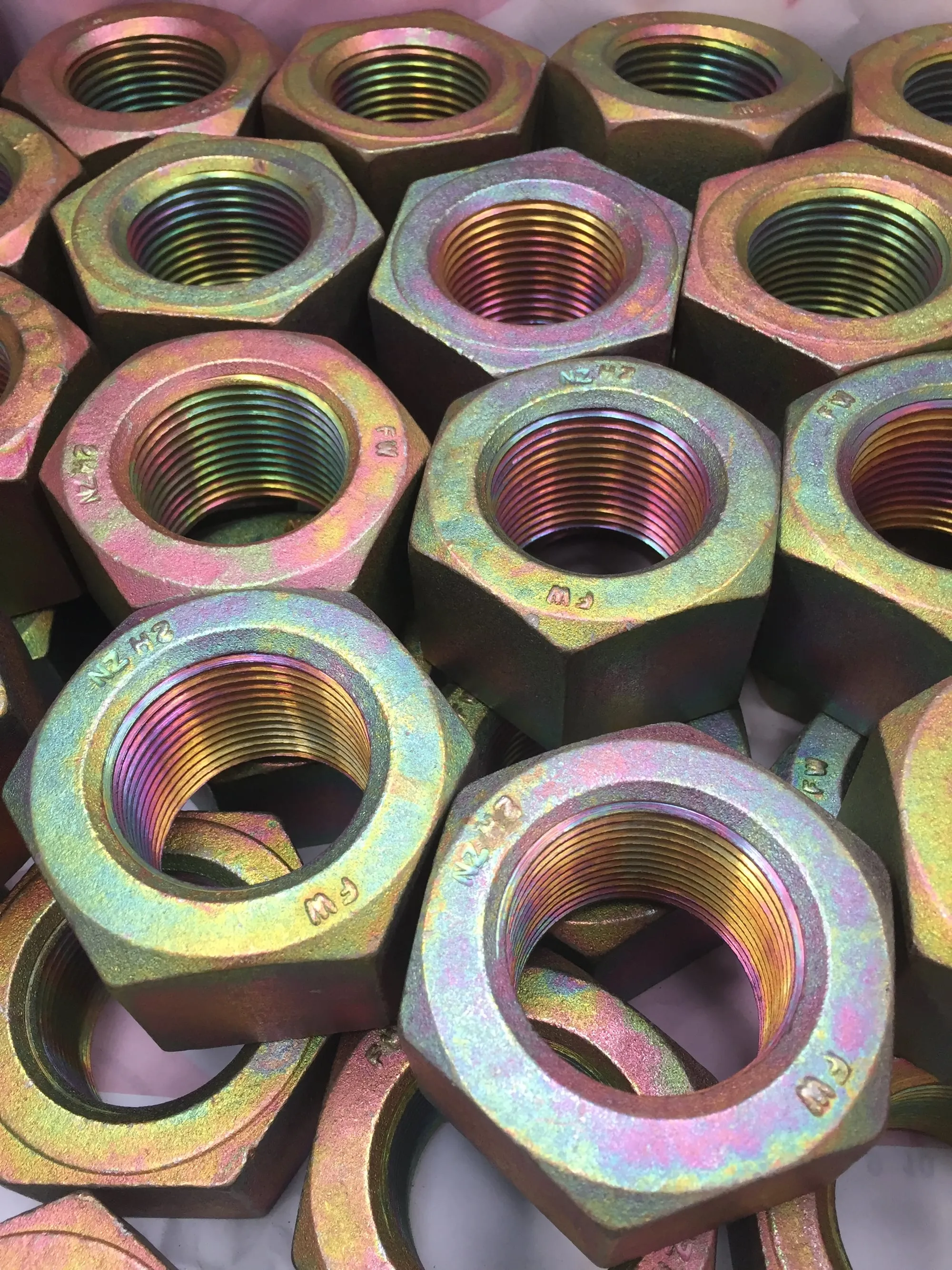
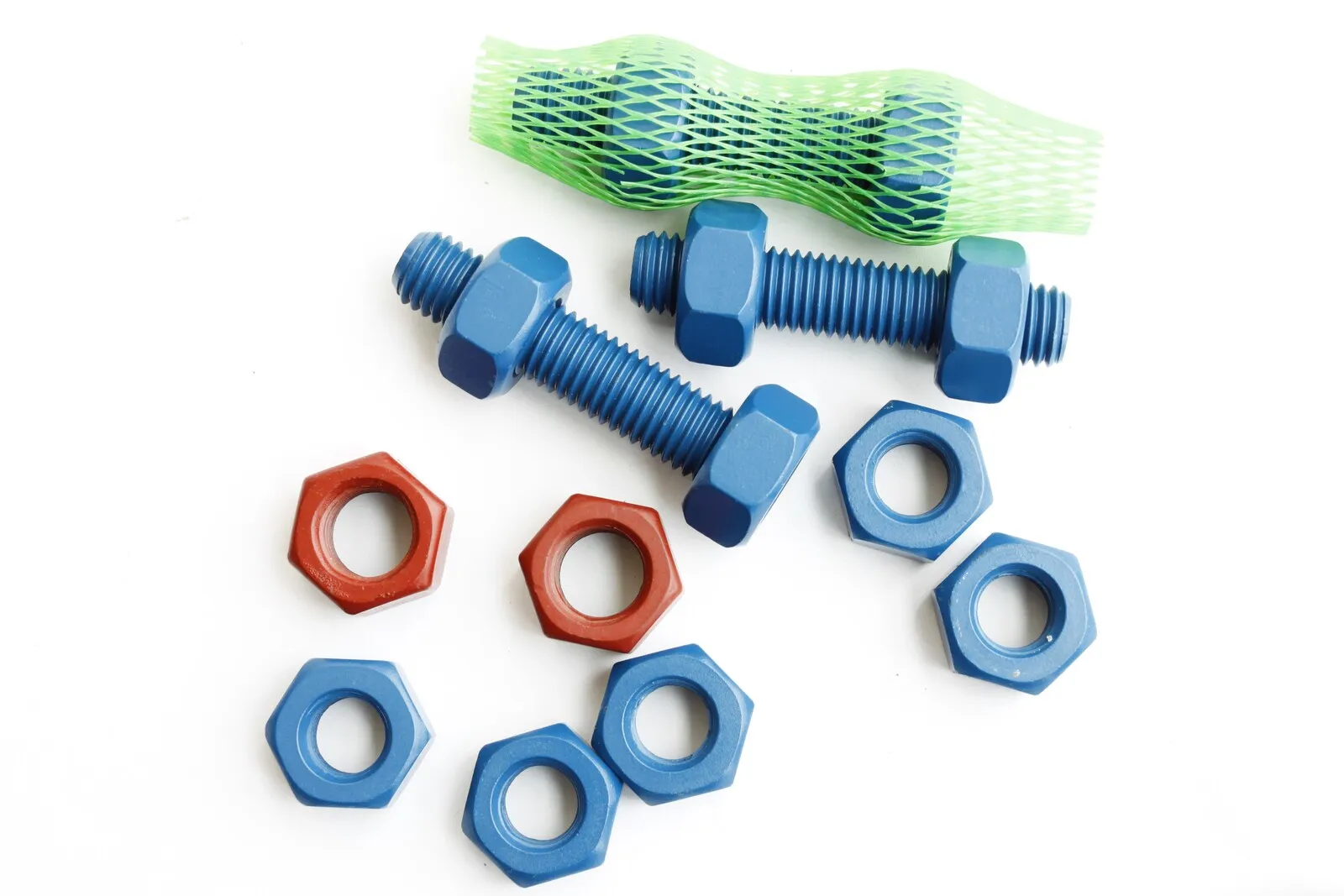
Xylan® from PPG: the color identifies the system applied, on the customer’s shop floor
Where the operator’s specification still requires cadmium, Sapucaia has applied it for about a decade for TechnipFMC, which keeps it on its approved-supplier list. The report comes to ASTM B117, with 1,000 h in an ISO/IEC 17025 accredited test.
ASTM B766 class 12 type II · ASTM B117 · TechnipFMC approved
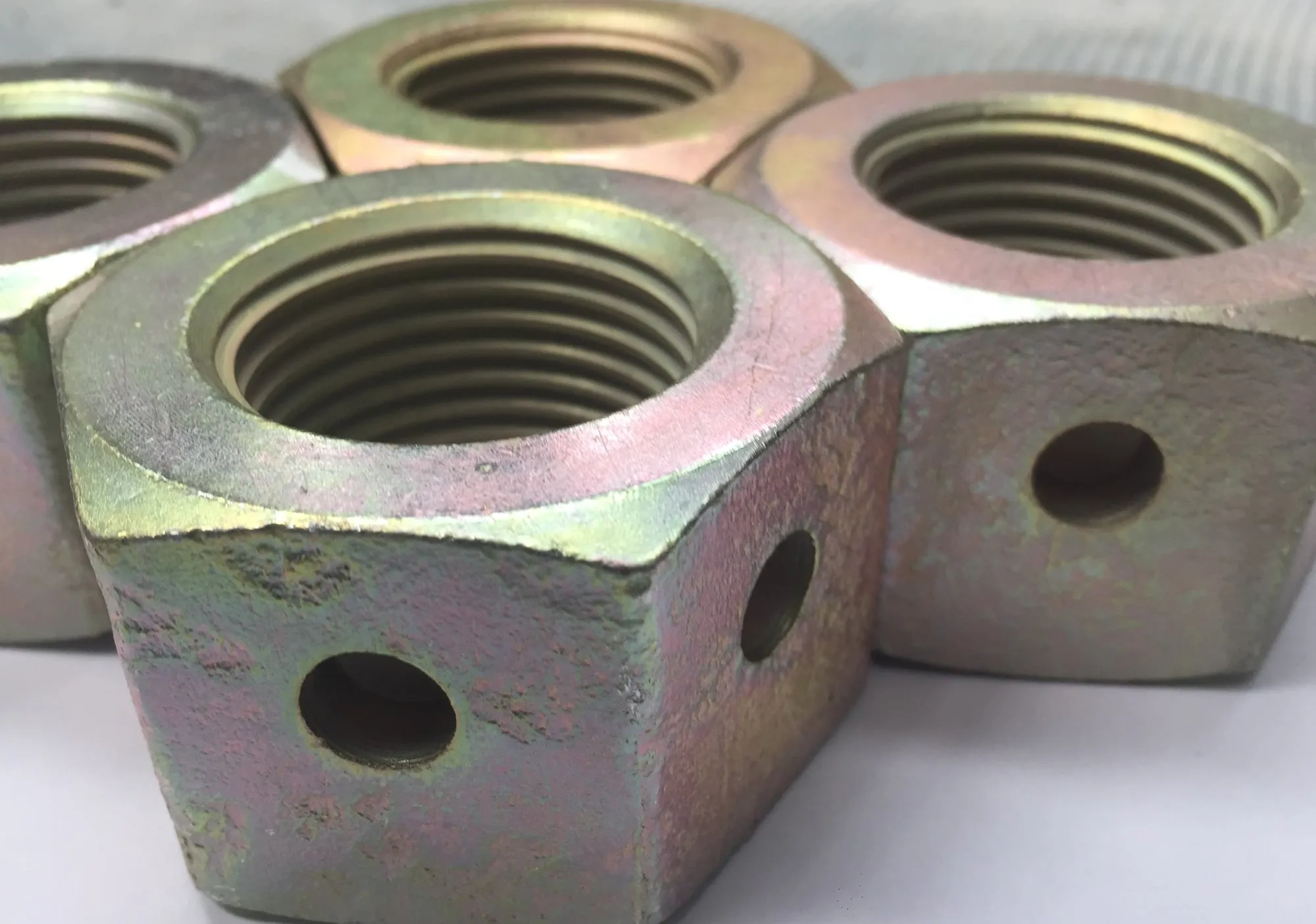
Nut in cadmium ASTM B766 class 12 type II — thin layer, thread kept within tolerance
What decides whether the coating adheres and whether the part does not fail by hydrogen. Hydrogen embrittlement relief at 150 °C to 250 °C in a calibrated oven, with the curve recorded by lot — an API 6A requirement, and Sapucaia declares TUS and SAT. Phosphate, zinc and manganese, as a conversion base, and blasting with stainless-steel shot or aluminum oxide to prepare the surface.
OEM and operator specifications met in the systems above.
Who specifies
Code
Subject
Petrobras
I-ET-3010.00-1200-251-P4X-001
Fastener coating
Petrobras
N-215
Zn, Zn-Ni and PTFE
Saudi Aramco
09-SAMSS-107
Fastener coating
ExxonMobil
GP 56-02-13
Fastener coating
Shell
DEP 30.48.00.32
Fastener coating
API
20E / 20F
Fasteners for oil & gas and subsea
API
Specification 6A
Oven calibration
03 / Laboratory
A thickness report says nothing about the alloy — and it is the alloy that corrodes.
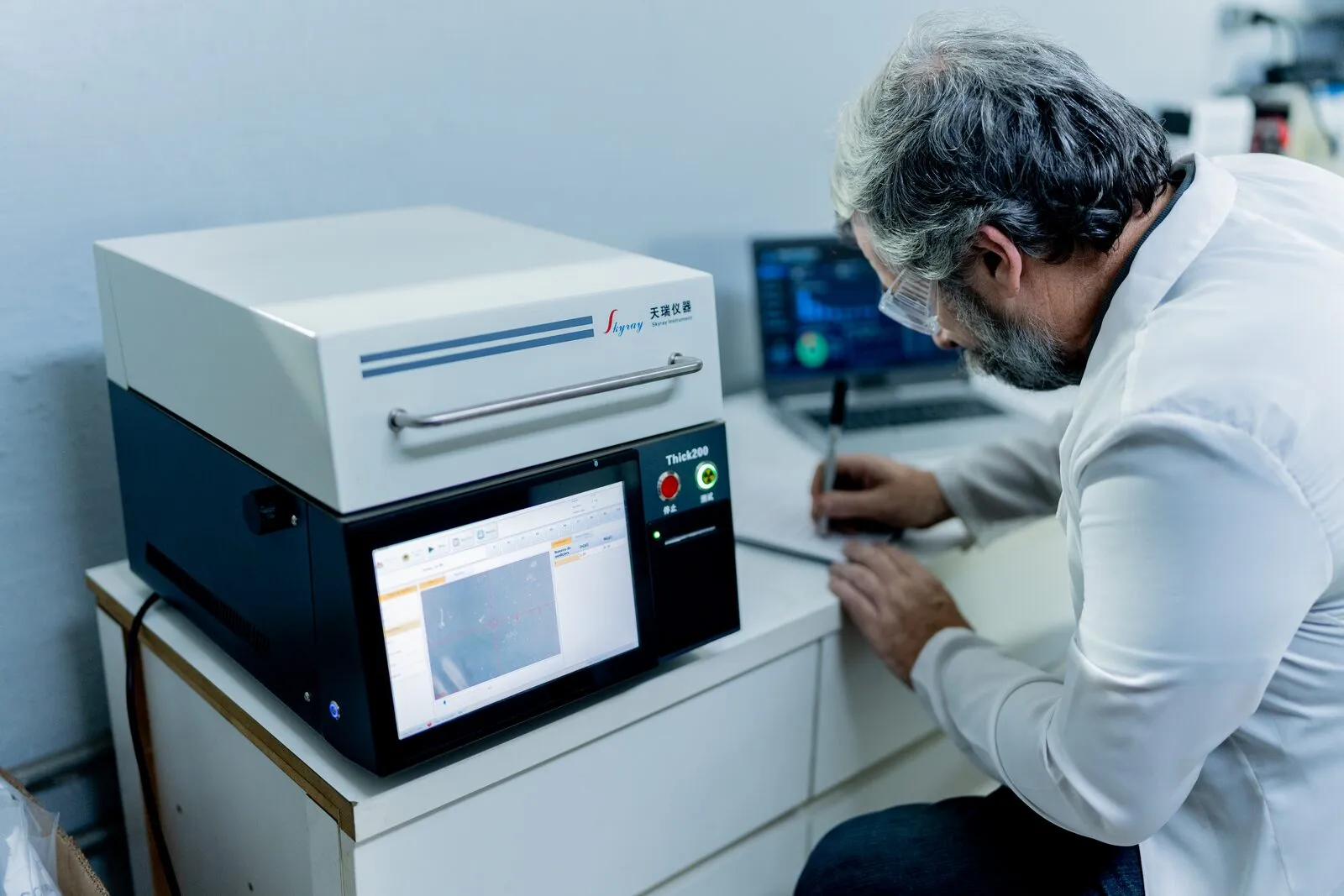
Two fasteners with the same coating in µm and different nickel percentages do not last the same time. X-ray fluorescence measurement reads both in the same reading, without destroying the part.
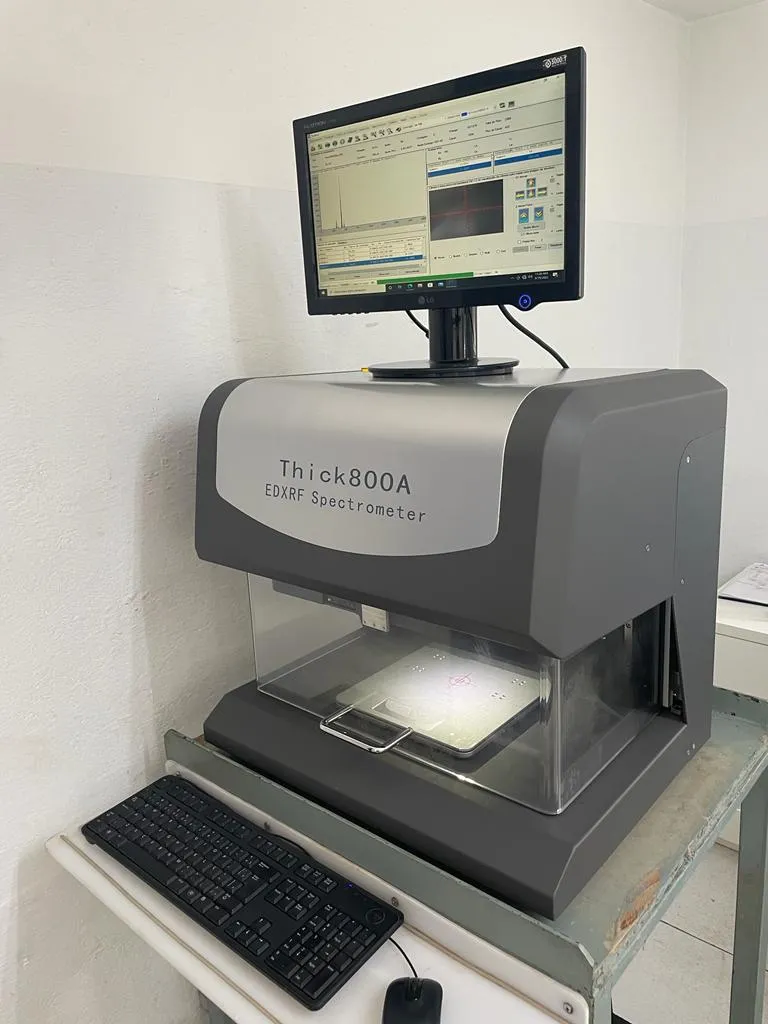
SpectrometersSkyray Thick200 XRF and Thick800A EDXRF — both in operation
What it measuresCoating thickness in µm and alloy percentage in Zn, Zn-Ni, Cd, Sn and Ni
Range required in Zn-Ni12 to 16% nickel
Bath analysisWet chemistry, Hull cell, Preece and Kesternich
Salt sprayOwn calibrated chamber · ASTM B117 and NBR 8094
Hydrogen embrittlement reliefCalibrated oven with TUS and SAT, to API 6A, with the curve recorded by lot
The calibration standards are traceable, checked by an ISO/IEC 17025 accredited laboratory. Publishing two spectrometers is not catalog vanity: it is what keeps process measurement going when one of them goes into calibration.
Send us one of your parts for measurement
Coated by us or by any other supplier. The Guarulhos laboratory measures coating and alloy and returns the report with the standard designation, not just the number. Collection is arranged with our sales team.
Coating thickness measured by X-ray fluorescenceThick800A — the first XRF in the house, now alongside the Skyray Thick200
04 / Meetings
After ROG.e, the conversation goes on.
Two formats, your choice. Tell us which works and our sales team confirms the date.
01
At your company
A meeting between our sales team and your engineering, with the resistance comparison of the systems we apply and your end customer’s specification on the table. Bring the part drawing and the coating standard.
02
At Sapucaia, in Guarulhos
The visit that is worth more than any catalog: the production line running, the laboratory with both spectrometers and the salt-spray chamber, on the date that works for you.
Our sales team replies within 1 business day. Have a drawing and a standard? Say so in the details and send the file by e-mail or WhatsApp — the form takes no attachments. For laboratory testing, choose “X-ray (XRF) measurement”.
We use this data only to answer your request. Submission is processed by Web3Forms (United States), which forwards it to vendas@sapucaia.com.
A copy is recorded in our sales system, on a server in Brazil, and the anti-spam check is run by Cloudflare.
The Sapucaia team was in Rio de Janeiro from September 21 to 24, 2026, at ROG.e. The conversation goes on in two formats: a meeting between our sales team and your engineering, at your company, or a visit to the plant in Guarulhos, with the production line and the laboratory in view. The request comes through the form on this page, by e-mail or by WhatsApp.
Does Sapucaia measure a part coated by another supplier?
+
Yes. Coated by Sapucaia or by any other supplier, the part is measured in the Guarulhos laboratory — coating thickness and alloy percentage by X-ray fluorescence — and the report comes with the standard designation. Collection is arranged with our sales team. A thickness report alone does not say which alloy it is, and it is the alloy that defines corrosion resistance.
Which coating is specified for oil and gas fasteners?
+
It depends on the asset and on the operator’s specification. NanoGalv® — nanolaminated zinc-nickel, with an exclusive licence in Brazil — passes 10,000 h to red rust from 10 µm, on manufacturer data. ASTM B841 class 2 zinc-nickel with a fluoropolymer finish is the system most sold for offshore fasteners. ASTM B766 class 12 type II cadmium remains where the specification still requires it.
Which oil and gas specifications does Sapucaia meet?
+
Petrobras I-ET-3010.00-1200-251-P4X-001 and N-215, Saudi Aramco 09-SAMSS-107, ExxonMobil GP 56-02-13, Shell DEP 30.48.00.32, API 20E and 20F, and API Specification 6A for oven calibration. Petrobras coating specifications converge on the same ASTM standards — ASTM B766, ASTM B841, ASTM B633 and the fluoropolymer — and we apply all four; our in-house laboratory runs the analyses for your project. The approvals are TechnipFMC, IBQN and PPG/Whitford.