
ASTM B841 Class 2 · Grade 10 · no passivation
Zinc-nickel plating with a PTFE top coat: the base protects, the top controls torque.
The system the oil and gas sector specifies when a fastener needs both things — a corrosion barrier and a predictable friction coefficient. With the fluoropolymer finish over an 8 to 15 µm base, that is over 3,500 h of salt spray — with PTFE Sapucaia, in independent external laboratory testing, and the same level with Xylan® 1070 and 1424.
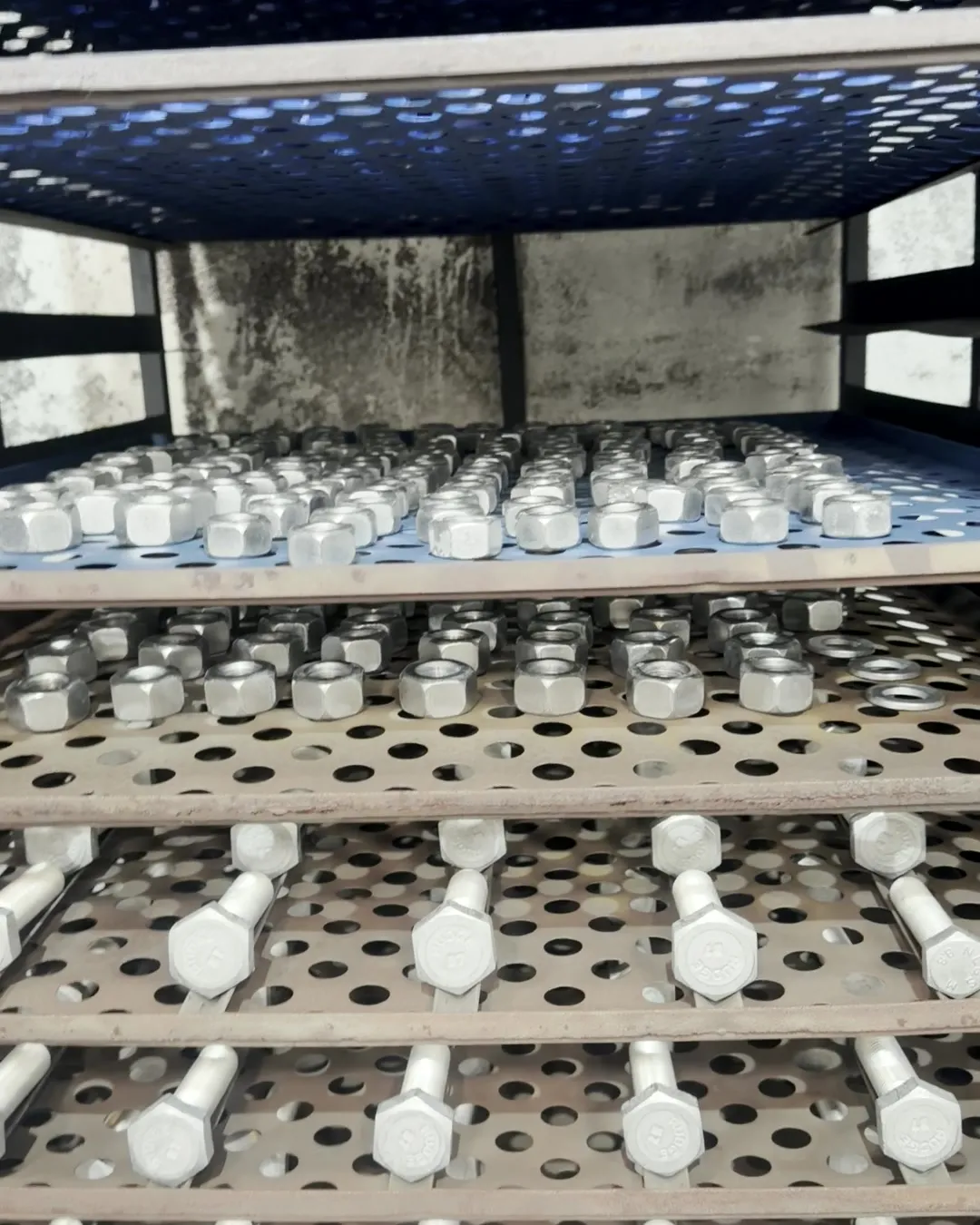
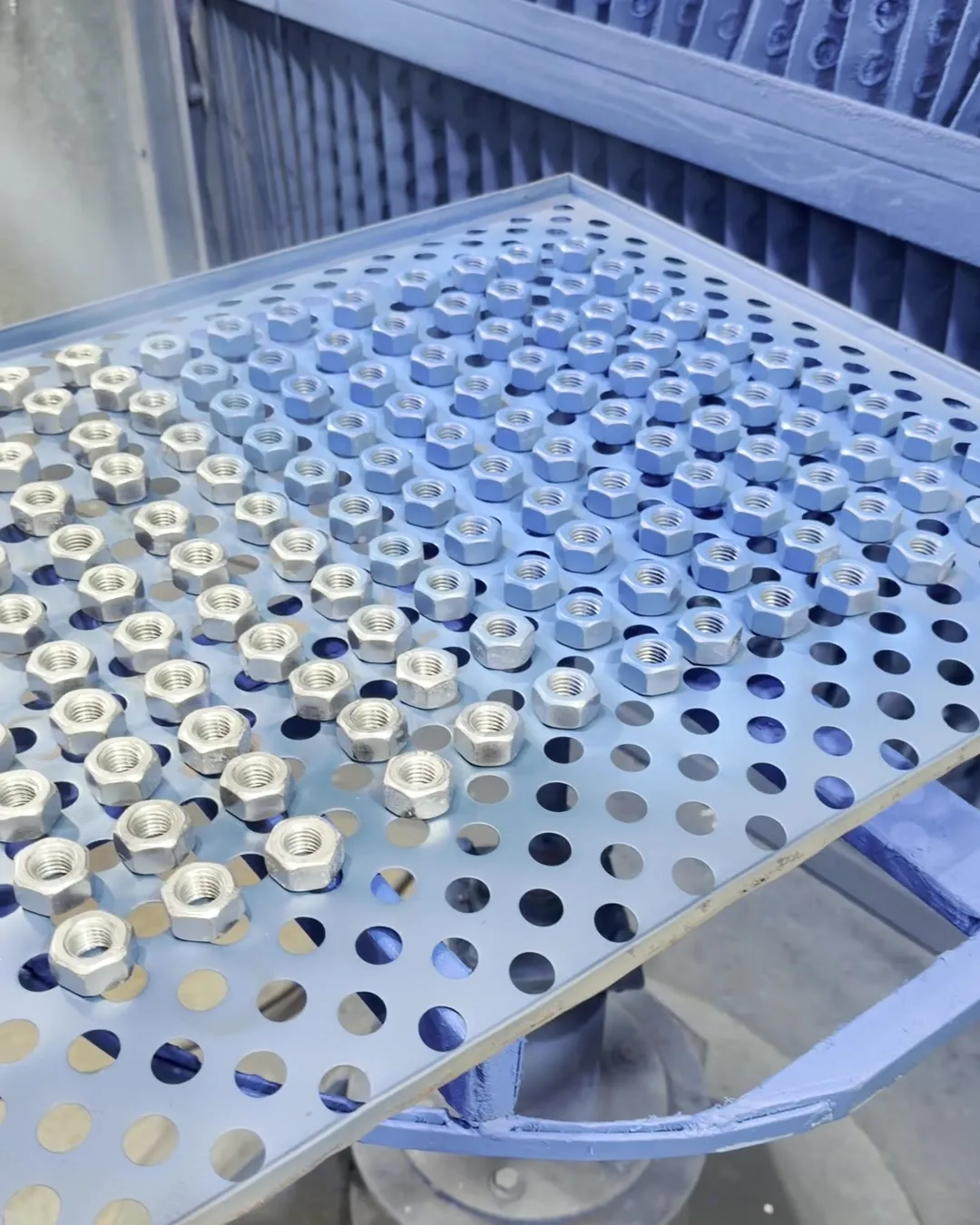
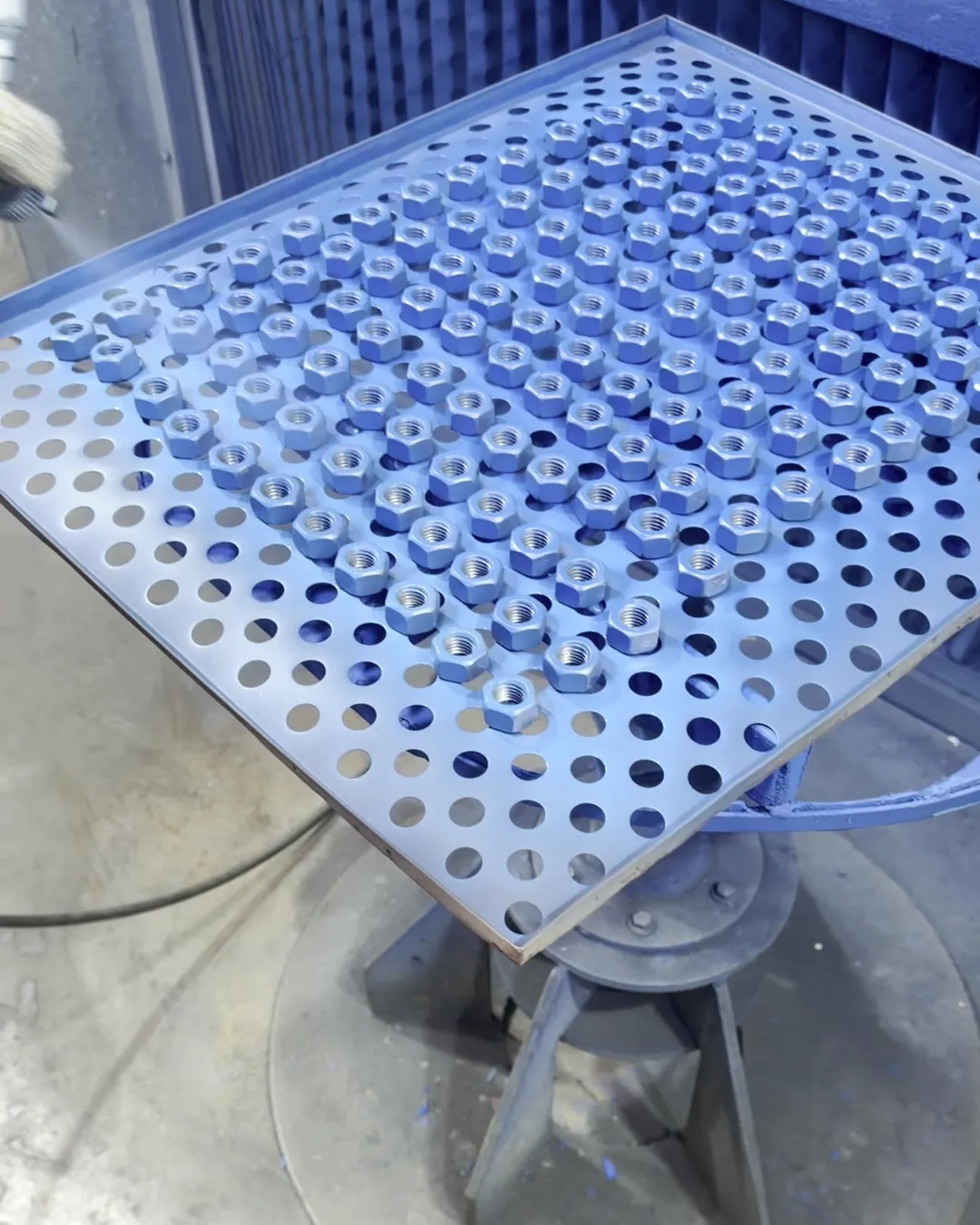
The two layers, filmed on the line
Sapucaia production record, filmed on the line in Guarulhos: the two layers of the system — the zinc-nickel ASTM B841 base and the Xylan® 1424 top coat applied by spraying —, the tray rotating so the layer comes out even and oven curing. Twenty-four seconds, with soundtrack.
What appears on screen, card by card
- 00:00 One layer alone does not protect the equipment. On screen, in Portuguese: Uma camada só não protege o equipamento.
- 00:03 Layer 1: zinc-nickel ASTM B841. On screen, in Portuguese: Camada 1: zinco-níquel ASTM B841.
- 00:06 Layer 2: Xylan® 1424, applied by spraying. On screen, in Portuguese: Camada 2: Xylan® 1424, aplicado por aspersão.
- 00:10 The tray rotates so the layer comes out even. On screen, in Portuguese: A bandeja gira para a camada sair uniforme.
- 00:12 Controlled oven curing. On screen, in Portuguese: Cura controlada em estufa.
- 00:16 Two processes. One single supplier. On screen, in Portuguese: Dois processos. Um único fornecedor.
- 00:19 Zinc-nickel ASTM B841 + Xylan® 1424 Complete duplex system for oil and gas On screen, in Portuguese: Zinco-níquel ASTM B841 + Xylan® 1424
The shots are from a single lot of fasteners. For your part, our sales team confirms system, class and thickness from the technical drawing and the coating standard.
Two layers, two different protections
Corrosion protection
The metallic base Zinc-nickel ASTM B841
It protects by sacrifice: the alloy corrodes before the steel, and keeps protecting where the layer was scratched during assembly. It accounts for almost all of the test hours.
Chemical resistance
The finish Xylan® 1424 · PTFE
It protects by barrier and by inertness: PTFE is one of the most inert polymers there is — the carbon-fluorine bond resists concentrated acid, alkali, solvent and strong oxidizer. It stops the process fluid that the metal alone does not stop.
One mechanism does not cover the other. A barrier alone fails at the first assembly scratch; sacrifice alone does not stop the process fluid.
What attacks the film is short and rare in oil and gas service: molten alkali metal and elemental fluorine. Outside of that, chemical attack is not the failure mode.
The number does not exist without the thickness and the system.
The three systems in the line deliver the same level of protection; what changes between them is temperature, friction and fluid. Publishing “over 3,500 hours” without saying over what is publishing a number nobody can check.
| System | Salt spray | Working range and remarks |
|---|---|---|
| Zinc-nickel + PTFE Sapucaia base 8 to 15 µm + top coat 15 to 25 µm | over 3,500 h independent external laboratory | The best-selling oil and gas system in the line. Tested at an independent external laboratory contracted by Sapucaia. |
| Zinc-nickel + Xylan® 1070 · solvent-based · 16 µm base 8 to 15 µm + top coat 16 µm | over 3,500 h Sapucaia technical data · ASTM B117 | Working range from −195 °C to 260 °C — the widest in the line. More than three and a half times zinc-nickel alone, with friction control added. |
| Zinc-nickel + Xylan® 1424 · water-based · 16 µm base 8 to 15 µm + top coat 16 µm | over 3,500 h performance specified by Sapucaia · ASTM B117 | Working range from −20 °C to 180 °C. Water-based, for process components where the chemical inertness of the fluoropolymer is the requirement. |
Salt-spray hours are not years of service life.
Specifiers know this, which is why it is worth saying: ASTM B117 warns, in its own text, that correlation and extrapolation of performance from the test are not always predictable, and should only be considered when long-term atmospheric exposure backs them up. The test is comparative — it ranks systems under reproducible conditions. It does not predict field life.
The reason is physical: continuous salt spray does not reproduce the wet-and-dry cycle, the temperature swings, the ultraviolet radiation or the varying chloride concentration of the real environment.
So the number serves what it serves: comparing. Zinc-nickel alone at 900 to 1,000 h, with a fluoropolymer top coat over 3,500 h — same red-rust criterion, more than three times. That ratio is sound. “Ten years on a platform” would not come out of this test.
For durability, the language is ISO 12944
It is where the project declares the environment and the expected life, and it is the vocabulary specifiers use:
- C5-M
- very high corrosivity, marine — coastal and offshore with high salinity
- CX
- extreme — high-salinity offshore, industrial with extreme humidity, tropical
- L · M · H · VH
- durability classes: up to 7 years · 7 to 15 · 15 to 25 · over 25
ISO 12944-9 deals specifically with offshore structures in CX, with cyclic testing — closer to reality than continuous salt spray.
Bring your project’s category and class and our sales team answers which system meets it, instead of comparing loose hours.
Scattered torque is unknown preload.
If zinc-nickel already protects against corrosion, why add the fluoropolymer? The answer is not in corrosion.
The fluoropolymer finish of the Xylan® 1070 line applied here measures 0.047 dynamic friction coefficient and 0.124 static, in ASTM G99 testing. Zinc-nickel plating with no finish, for comparison, has a high and unstable coefficient — fastener literature typically puts it between 0.25 and 0.35, and the problem is the scatter more than the absolute value.
In a bolted joint, this is not assembly comfort. The applied torque is split between overcoming friction and generating preload. If friction varies from part to part, the same torque produces a different preload in each bolt of the flange — and the joint works outside what the design calculated. In service with vibration or thermal cycling, that is where loss of tightness shows up.
The second gain is galling: the fluoropolymer prevents seizing on disassembly, which on a flange that will be opened for maintenance is the difference between replacing the gasket and cutting the bolt.
And the third is a chemical barrier: the fluoropolymer finish resists process fluid and solvent that the metal alone does not stop.
What the base and the top do, separately
| Base Zn-Ni ASTM B841 | Sacrificial protection — the coating corrodes before the steel. It is what gives the part its life, and what accounts for almost all of the test hours. |
|---|---|
| Top fluoropolymer | Barrier protection + controlled friction + chemical resistance. It is what makes the joint assemble predictably and come apart without galling. µ 0.047 dynamic · 0.124 static · ASTM G99 |
One does not replace the other. A barrier alone fails at the first assembly scratch; sacrificial alone assembles with unpredictable torque.
“ASTM B841” on its own specifies nothing.
The standard has class and grade, and without both, two suppliers deliver different things and both say they complied. In this system there is a third item, and it is an absence: there is no passivation, because there is a paint finish.
| Part | What it fixes | |
|---|---|---|
| Class 2 | 12 to 16% nickel by weight | Class 2 came in with the 2018 revision. Class 1 is 5 to 12%. |
| Grade 10 | minimum thickness of 10 µm on the base | The grade IS the minimum thickness in micrometers. There are grades 5, 8 and 10. |
| No passivation | a system with an organic finish carries no passivation layer | Passivation and paint do not coexist. That is why this system’s designation carries no passivation type — whoever specifies Zn-Ni without paint is the one who declares the type. |
API 20E defines how much the project demands
For oil and gas bolting, API 20E sets three specification levels — and it is the level, not the buyer’s taste, that defines the rigor of testing, traceability and documentation. The coating enters as a controlled requirement of thickness, adhesion and hydrogen embrittlement relief.
- BSL-1
- less critical service, where bolt failure causes no catastrophic damage
- BSL-2
- medium risk — stricter testing and documentation
- BSL-3
- failure is unacceptable. The usual definition is an application where bolt failure releases hydrocarbon to the atmosphere
Hydrogen relief is not a detail: in a high-strength bolt, hydrogen absorbed in the bath embrittles the steel and the failure appears later, in service. That is why hydrogen embrittlement relief is part of the system, not an extra — see hydrogen embrittlement relief.
Operator specifications met
We cite the specification, not the customer. It is what your drawing references.
- I-ET-3010.00-1200-251-P4X-001 Petrobras — Fastener coating
- N-215 Petrobras — Zn, Zn-Ni and PTFE
- 09-SAMSS-107 Saudi Aramco — Fastener coating
- GP 56-02-13 ExxonMobil — Fastener coating
- DEP 30.48.00.32 Shell — Fastener coating
- 20E / 20F API — Fasteners for oil & gas and subsea
- Specification 6A API — Oven calibration
PFAS: a long-project risk, not today’s.
PTFE belongs to the PFAS family, and the European Union is in the middle of a broad restriction. The state of play, as measured in September 2026: in March 2026 the two scientific committees of ECHA — risk assessment and socio-economic analysis — voiced support for an EU-wide restriction, with targeted derogations. The request to exclude fluoropolymers altogether was not accepted, but they received separate regulatory treatment, with an option that allows continued use under emission-containment conditions. The public consultation closed in May 2026, and the final opinion was expected before year end.
In practice, for whoever buys coated fasteners today, this changes nothing. For whoever designs a 25-year asset, it is a variable to consider — and it is honest to say so, rather than sell fluoropolymer as if there were no discussion.
If the requirement is to leave PFAS
The route in the portfolio is NanoGalv®: nanostructured zinc-nickel to ASTM B1025-25, PFAS-free, with over 10,000 h of salt spray from 10 µm — ASTM B117 testing by Modumetal, the technology licensor.
It solves corrosion without a top coat. What the fluoropolymer adds there is controlled friction and a chemical barrier — and that is where the NanoGalv® + Xylan® system sits at the top of the portfolio.
What they ask before closing the drawing.
How many salt-spray hours does zinc-nickel with PTFE withstand?
Over 3,500 hours, on a zinc-nickel base of 8 to 15 µm — that is the level of the three combined systems in the line: PTFE Sapucaia (top coat of 15 to 25 µm), Xylan® 1070 (solvent-based, top coat of 16 µm) and Xylan® 1424 (water-based, top coat of 16 µm). The choice among them is not made on test hours, but on temperature range, friction and process fluid. Zinc-nickel alone sits at 900 to 1,000 hours — the finish multiplies that by more than three. Every hour here comes with the thickness, the system and the source of the data, because the number means nothing without all three.
Do salt-spray hours equal years of service life?
No, and ASTM B117 itself says so: correlation and extrapolation from the test are not always predictable, and should only be considered when long-term atmospheric exposure backs them up. The test serves to compare systems under reproducible conditions, not to predict field life. For design durability, the language is ISO 12944: corrosivity category (C5-M in marine environments, CX offshore) and durability class.
How do I specify this system on the drawing?
By base and finish, separately. The base is ASTM B841 class 2, grade 10: an alloy of 12 to 16% nickel, minimum thickness of 10 µm. The finish is the fluoropolymer, with the layer and the line set by the application. No passivation type applies: passivation and paint do not coexist, and a system with an organic finish carries no passivated layer. If your drawing has a type field, bring the end customer’s specification and our sales team confirms what to fill in.
Why add PTFE if zinc-nickel already protects?
Because corrosion is not the only requirement of the joint. Zinc-nickel with no finish has a high, unstable friction coefficient, and on a fastener that means scattered torque and unknown preload — the joint working outside what the design calculated. The Xylan® 1070 finish applied here measures 0.047 dynamic and 0.124 static friction in ASTM G99, against the 0.25 to 0.35 typical of bare zinc-nickel in the fastener literature. You also gain a chemical barrier against process fluid and protection against galling on disassembly.
Does the European PFAS restriction affect this system?
It is a horizon risk, not today’s, and worth considering on a long-life project. In March 2026 the two scientific committees of ECHA backed the broad PFAS restriction in the European Union, with targeted derogations; the request to exclude fluoropolymers altogether was not accepted, but they received separate regulatory treatment, with an option that allows continued use under emission-containment conditions. The consultation closed in May 2026 and the final opinion was expected by year end. For those who want to leave the PFAS family, the route in our portfolio is NanoGalv®, which is PFAS-free.
Does it suit API 20E BSL-3?
API 20E defines three levels of bolting specification, and BSL-3 is the one where failure is unacceptable. The coating enters there as a controlled requirement of thickness, adhesion and hydrogen embrittlement relief — not as an aesthetic choice. We serve all three levels according to the project specification; bring your end customer’s document and our sales team confirms item by item.