Xylan 1425
Water-based coating with dual PTFE and MoS₂ lubrication, for high pressure at low speed and continuous service from −50 °C to +175 °C.
What defines the 1425 is dry lubrication by a dual system: PTFE and molybdenum disulfide in the same formulation. One performs better at low load, the other under high pressure — together, they keep the friction coefficient low across a working range neither covers alone.
That is why it appears in high-pressure, low-speed applications: a threaded joint that tightens slowly under high load, where the film must hold without being squeezed out of the contact.
Being water-based and resin-bound, it resists water-based hydraulic fluid — which is used in offshore oil production. It is a choice of chemical compatibility with the working fluid, not of finish.
Anyone looking for molybdenum disulfide without PTFE has a datasheet of its own: molybdenum disulfide (MoS₂), where MoS₂ is the main lubricant and the finish is gray.
Note: The corrosion resistance of this finish can be reinforced with a zinc-nickel base underneath, which adds sacrificial galvanic protection to the barrier of the film. The sales team reports the result for the specified system — tell us the standard of your end customer and the intended metallic base.
Manufacturer data sheet
manufacturer data — data sheet for Xylan® 1425, not a Sapucaia test
- Lubrication
- PTFE + MoS₂ — dual system, dry
- Base
- Water and resin
- Continuous use
- −50 °C to +175 °C
- Peak withstood
- +204 °C
- Friction coefficient
- 0.05 to 0.10
- Pressure · low speed
- up to 150,000 psi
- Pencil hardness
- 2 to 3 H
- Dielectric strength
- 500 V/mil
- Recommended thickness
- 20 to 30 µm
- Salt spray · ASTM B117
- exceeded 1,500 h
- Kesternich · DIN 50018
- 30 cycles · less than 15% red rust
- Colors
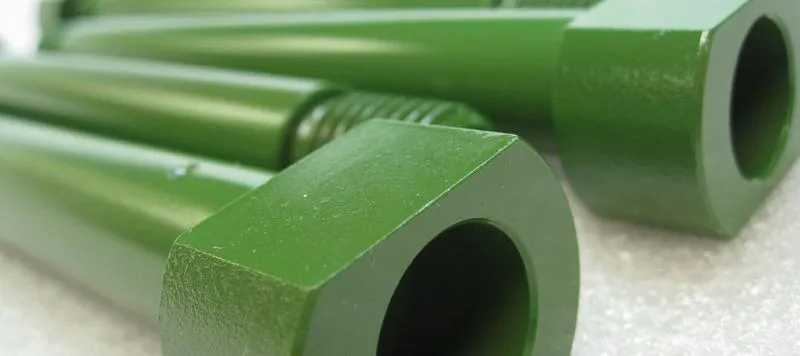
- Black · blue · green
The applications that come here.
High-pressure joint
Studs and stud bolts that tighten under high load at low speed, where the lubricant film decides the final torque.
Contact with aqueous hydraulic fluid
Component exposed to the control fluid used in offshore production, for which the water-based formulation was designed.
Industrial environment with sulfur
Where the reference test is Kesternich, not only salt spray — refinery and chemical-plant atmosphere.
What specifiers usually ask.
What is the difference between Xylan® 1425 and 1070?
The base and the temperature range. The 1425 is water-based, with dual PTFE and MoS₂ lubrication, and works in continuous service from −50 °C to +175 °C. The 1070 is solvent-based and covers −195 °C to 260 °C. The 1425 is the choice for high pressure at low speed and for contact with aqueous hydraulic fluid.
Is the 1425 test data from Sapucaia?
No: it comes from the datasheet of the coating manufacturer, and the page says so beside each number. Sapucaia is approved by PPG to apply the line, and what it proves in its own report is the applied thickness and the system delivered — not the formulation of the product.
In which colors is the 1425 applied?
Black, blue and green. Color usually serves as system identification at the customer’s goods-in, and does not indicate performance: all three finishes come from the same formulation.