
From the part to the certificate, all inside the plant.
Eight treatment lines, an in-house laboratory and quality release — in Guarulhos, with no step outsourced.
The six steps, in order.
Receiving
Weighing, invoice check and preparation of the work order (WO). The WO is what triggers and tracks all production.
Cleaning line
Hot degreaser, acid, rinse waters and neutralization. 100% of parts pass through it — it is a resource common to the whole volume.
Automatic machine
Cleaning, electrolytic degreaser, rinse, acid, rinse and the electrodeposition bath. The operator loads with the WO in hand.
Finishing
Passivation, sealing where applicable and centrifuging.
Hydrogen embrittlement relief
For high-hardness fasteners: hydrogen relief between 150 °C and 250 °C, in an oven with TUS and traceable calibration to API 6A.
Release and dispatch
Coating and alloy reading by X-ray, quality release and the lot’s test certificate.
The WO closes only with two signatures.
Traceability that depends on memory is not traceability. These are the three points where the process obliges itself to leave a record.
Whoever produced signs; whoever ships accepts — or sends it back
The person responsible for production signs the WO with date and time and sends the part to dispatch together with it. Dispatch accepts and signs, or refuses and returns it to whoever produced it. Two different people look at the same lot before it leaves.
The tag carries load, time and occupancy
Together with the WO, the office issues to the section a tag with the load in kilograms, the bath minutes and the total minutes of plant occupancy, plus the notes for that product. Load and time are calculated by material, not estimated on the floor.
The invoice does not go out before the laboratory
Each part is treated as a product: the maximum and minimum coating, the part type, the material thickness, the bath, the color, the load, the time and the precautions are all recorded. When a certificate of conformity is required, the invoice is issued only with the laboratory measurements and the tests done.
Packaging goes on the WO too
Packaging type, number of packages, the condition in which the packaging arrived, whether it is identified or not, and the expected return date of the parts. It is what prevents the damage argument after shipping.
Load and time come from an equation, not an estimate.
The area being plated determines the current density, and the current density determines the coating. That is why the load of every rack and every barrel is calculated by part type, and not adjusted by eye — it is the same equation for the first lot and for the thousandth.
Electrolytic bath
load kg = (fe × A × T × mm) ÷ (c × m)
Chemical bath
load kg = (tank dm² × part thickness) ÷ c
- fe
- electrolyte efficiency factor
- A
- amperage, or dm² of tank capacity
- T
- time, in minutes
- mm
- material thickness
- m
- deposit thickness, in microns
- c
- material-type constant
The electrolyte efficiency factor is not tabulated: it comes from the Hull cell in our laboratory, with rectifier and automatic timer. That is why the calculation follows the bath as it is today, and not as it was when it was made up.
| Material type | Constant (c) |
|---|---|
| Nut | 110 |
| Bolt | 80.81 |
| Wire | 50.96 |
| Iron sheet | 25.48 |
| Tube | 12.74 |
The cleaning line is common to 100% of the volume.
A stoppage there affects everything. That is why cleaning gets the same process attention as the bath — a coating does not adhere to a poorly prepared surface, and the defect only shows up in the test.
The point most dependent on operator skill is the automatic plating machine. It is where experience decides whether the lot comes out conforming — and that is why training recorded by role and process is part of the system, not an ISO formality.
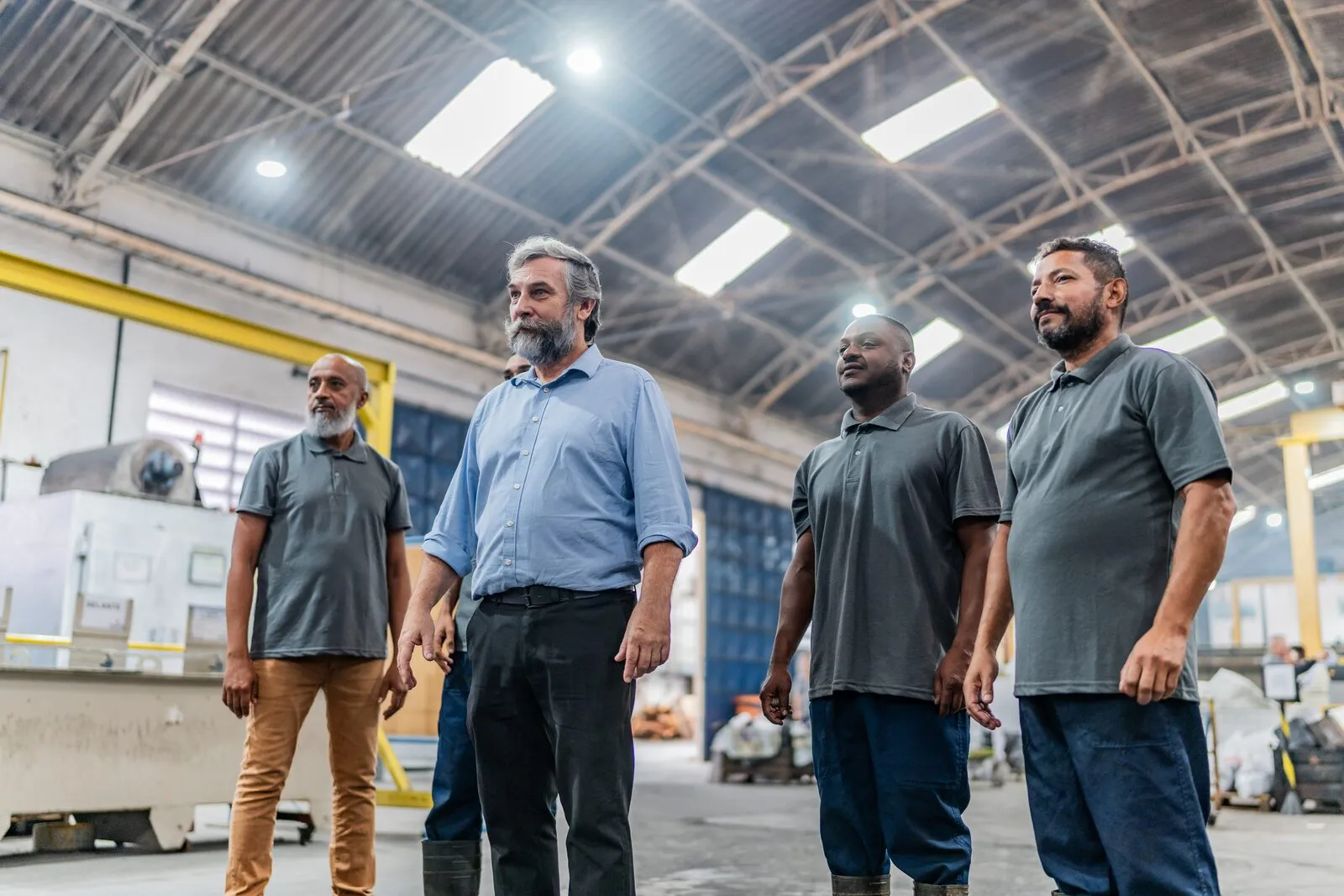
Floor meeting · indicators and the previous shift’s nonconformities
How does Sapucaia trace a lot?
By the work order. The WO is created at receiving, follows the part through the whole line and receives the record of each step. Linked to it are the X-ray coating reading and the bath replenishments logged in the period — so it is possible to reconstruct the conditions under which that lot was processed.
What is the shift pattern?
The rotating machines (barrel) — alkaline zinc, zinc-nickel and pickling — run in two shifts. The still-bath and rack lines — cadmium, painting and phosphate — run in one shift.