Abrasive blasting before coating
Blasting with stainless-steel shot and with aluminum oxide, for cleaning, surface preparation and coating anchoring.
Stainless-steel shot cleans without contaminating the part with free iron; aluminum oxide gives an anchor profile for organic systems.
In oil and gas, blasting is not a finish: it is a requirement. Some of the sector’s standards demand it before cadmium, zinc-nickel or zinc processing, to guarantee that the quench and forging scale has come off the forged part completely. A layer deposited over scale adheres to the scale, not to the steel — and comes off with it.
There is a less obvious gain, and it is one of product safety. Cleaning by blasting reduces the need for acid in the pickle, and less acid means less nascent hydrogen entering the steel. In a high-hardness fastener, that lowers the risk of hydrogen embrittlement even before the part reaches the relief oven.
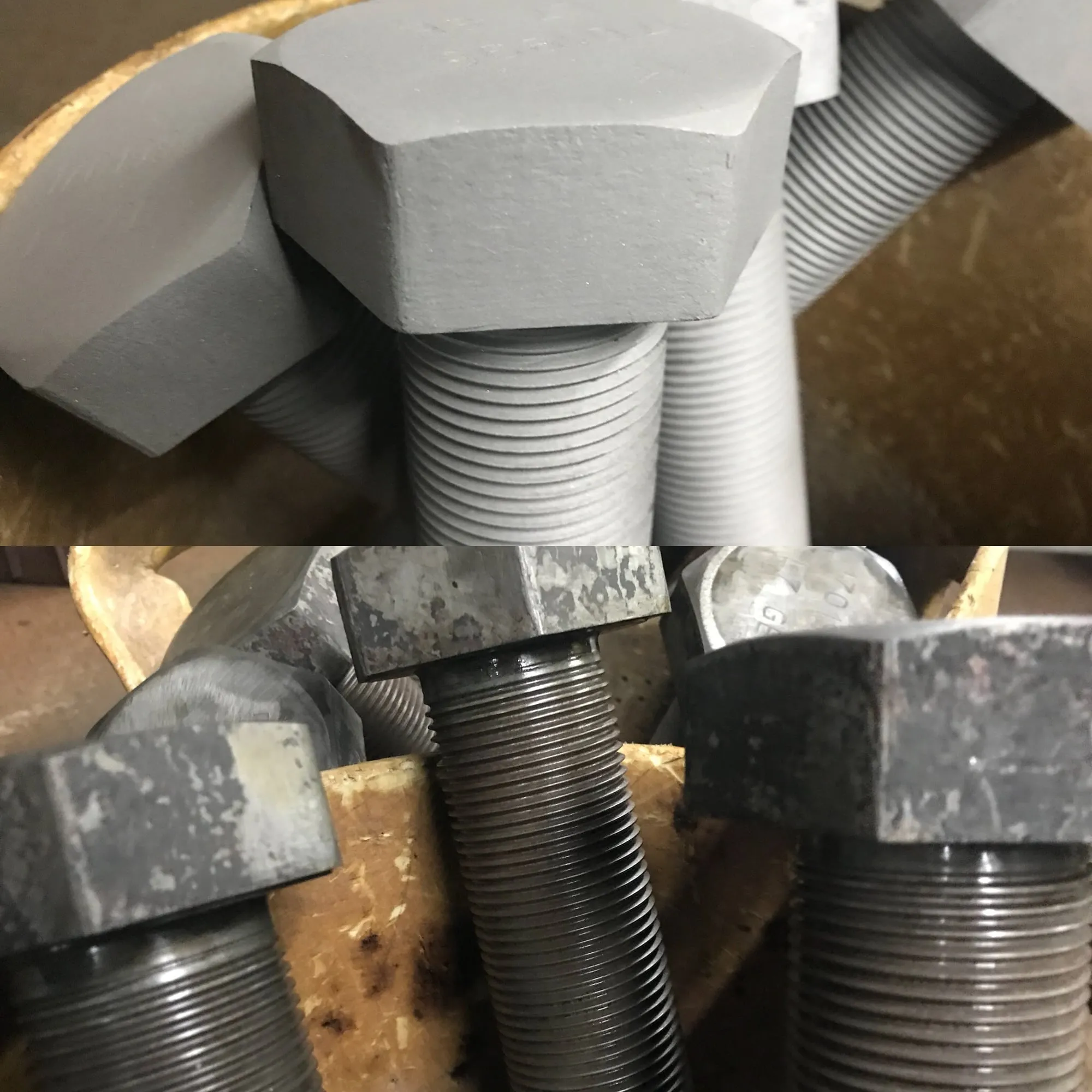
Stainless-steel shot is spherical and cleans without contaminating the part with free iron — which matters when the substrate is stainless and any embedded ferrous particle becomes a corrosion point. It removes quench scale and the milder burr from rolling, and serves the recovery of already-used parts.
Aluminum oxide is angular and gives an anchor profile for an organic system. It is applied manually, which serves two cases the rotary machine does not solve: parts sensitive to impact, such as fine threads, and parts too large to enter the equipment.
Technical data
- Abrasives
- Stainless-steel shot · aluminum oxide
The applications that come here.
Before the bath, in oil & gas
Removal of quench and forging scale on hexagonal and socket-head bolts, when the project standard requires the surface to be clean before coating.
Anchor profile
Aluminum oxide before an organic system, so the coating has something to hold onto mechanically.
Stainless parts
Stainless-steel shot, which cleans without leaving embedded free iron — the contamination that becomes a corrosion point on a substrate that should not corrode.
Recovery and large parts
Parts already in service or outside the rotary machine’s gauge, treated in manual blasting.
Variations of this line.
What specifiers usually ask.
Why blast before coating?
Because a coating applied over scale adheres to the scale, not to the steel — and comes off with it. Scale is the oxide that quenching and forging leave on the surface, and some oil and gas standards require its removal before cadmium, zinc-nickel and zinc.
Does blasting reduce the risk of hydrogen embrittlement?
It does, indirectly and meaningfully. Mechanical cleaning lowers the need for acid in pickling, and it is the acid that generates the nascent hydrogen that enters the steel. In a high-hardness fastener, that adds to hydrogen embrittlement relief rather than replacing it.
Which abrasive to use: stainless-steel shot or aluminum oxide?
It depends on the substrate and on what comes next. Stainless-steel shot to clean without contaminating with free iron, mainly on stainless parts. Aluminum oxide when the goal is an anchor profile for organic coating, or when the part is sensitive to impact and needs manual application.