Aluminum-oxide blasting
Creates the roughness profile that organic coating needs to anchor.
Aluminum oxide is an angular abrasive: instead of only cleaning, it creates an anchor profile. It is the preparation used before organic systems that depend on roughness to adhere.
In oil and gas, it is also a requirement. Some of the sector’s standards require blasting before cadmium, zinc-nickel and zinc processing, to make sure the heat-treat and forging scale has come off the forged part completely — a layer deposited over scale comes loose along with it.
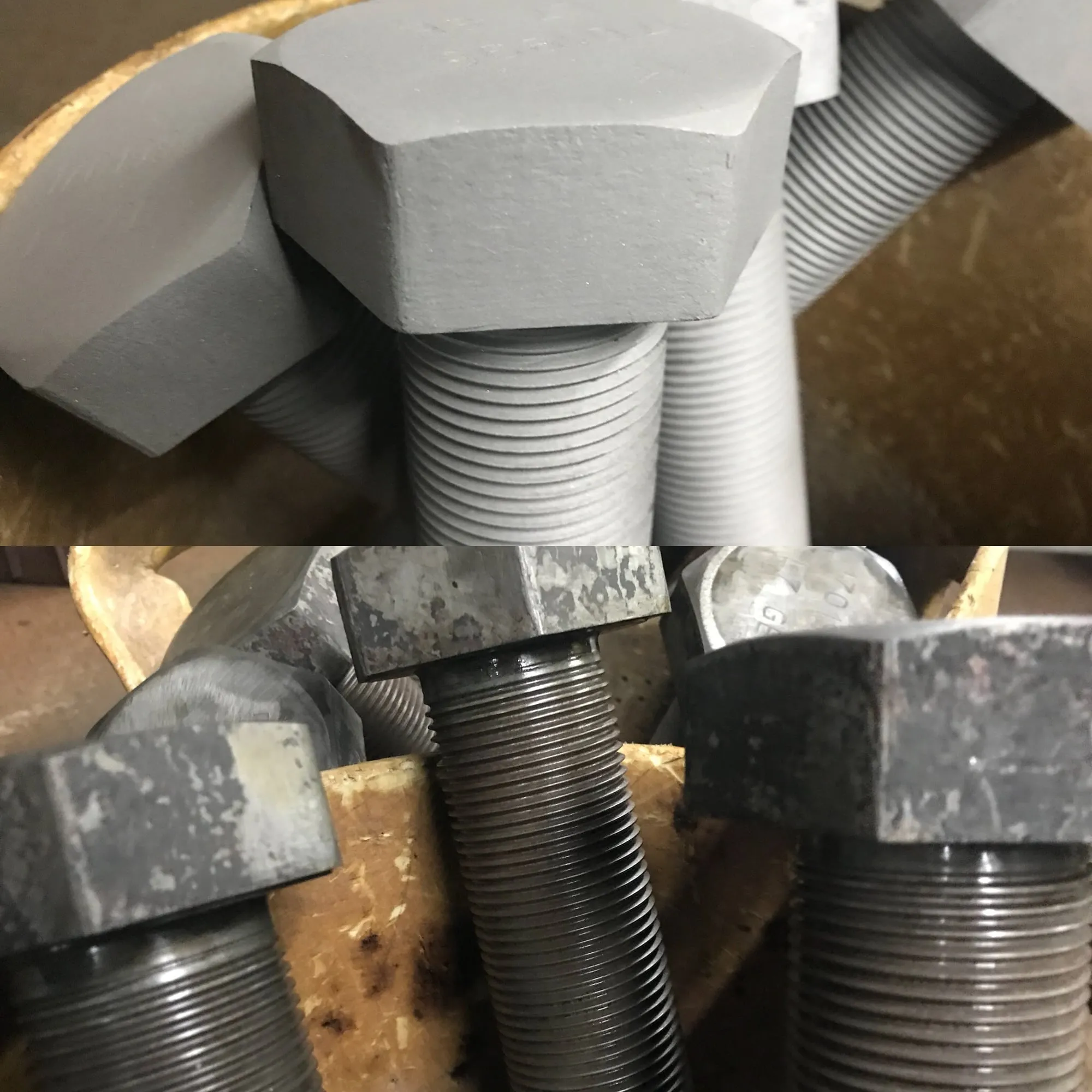
Application is manual, and that solves two cases the rotary machine does not serve: parts sensitive to impact, such as the fine thread of a hex or socket-head screw, and parts too large to enter the equipment.
There is a product-safety gain that does not show in the finish: cleaning by blasting reduces the need for acid in pickling, and less acid means less nascent hydrogen entering the steel. On high-hardness fasteners, this adds to hydrogen embrittlement relief rather than replacing it.
Technical data
- Abrasive
- Aluminum oxide · angular
- Application
- Manual
- Function
- Anchor profile · scale removal
- Indirect gain
- Less acid in cleaning, less hydrogen in the steel
The applications that come here.
Requirement before the bath
Removal of heat-treat and forging scale when the oil and gas standard requires it before cadmium, zinc-nickel or zinc.
Anchor profile
Roughness so organic coating and thermal spray hold mechanically.
Sensitive or large part
Fine threads and components outside the gauge of the rotary machine, handled in manual blasting.