
Black zinc-nickel
A uniform black finish without giving up protection — the same controlled zinc-nickel alloy, with black trivalent passivation and sealer. It is a different coating from black zinc.
Black trivalent solves the case where the part needs a dark finish and corrosion protection at the same time. The black chromate conversion does not impair zinc-nickel performance — it works in a rotating barrel and on a rack alike.
Black trivalent passivation is chosen for two reasons that often go together: visual identification of a system at the customer’s goods-in, and the cosmetic requirement of an assembled part in plain sight. In both cases, protection still comes from the alloy, the thickness and the sealer — not from the color.
For a dark finish on a part that also needs friction control, the route is usually different: black fluoropolymer over the metallic base, as a system. The designation changes there, because where there is an organic layer there is no finish passivation.
Technical data
- Passivation
- Black trivalent (Cr³⁺)
- Alloy
- 12 to 16% nickel
- Sealer
- Applied to specification
- Standard
- ASTM B841
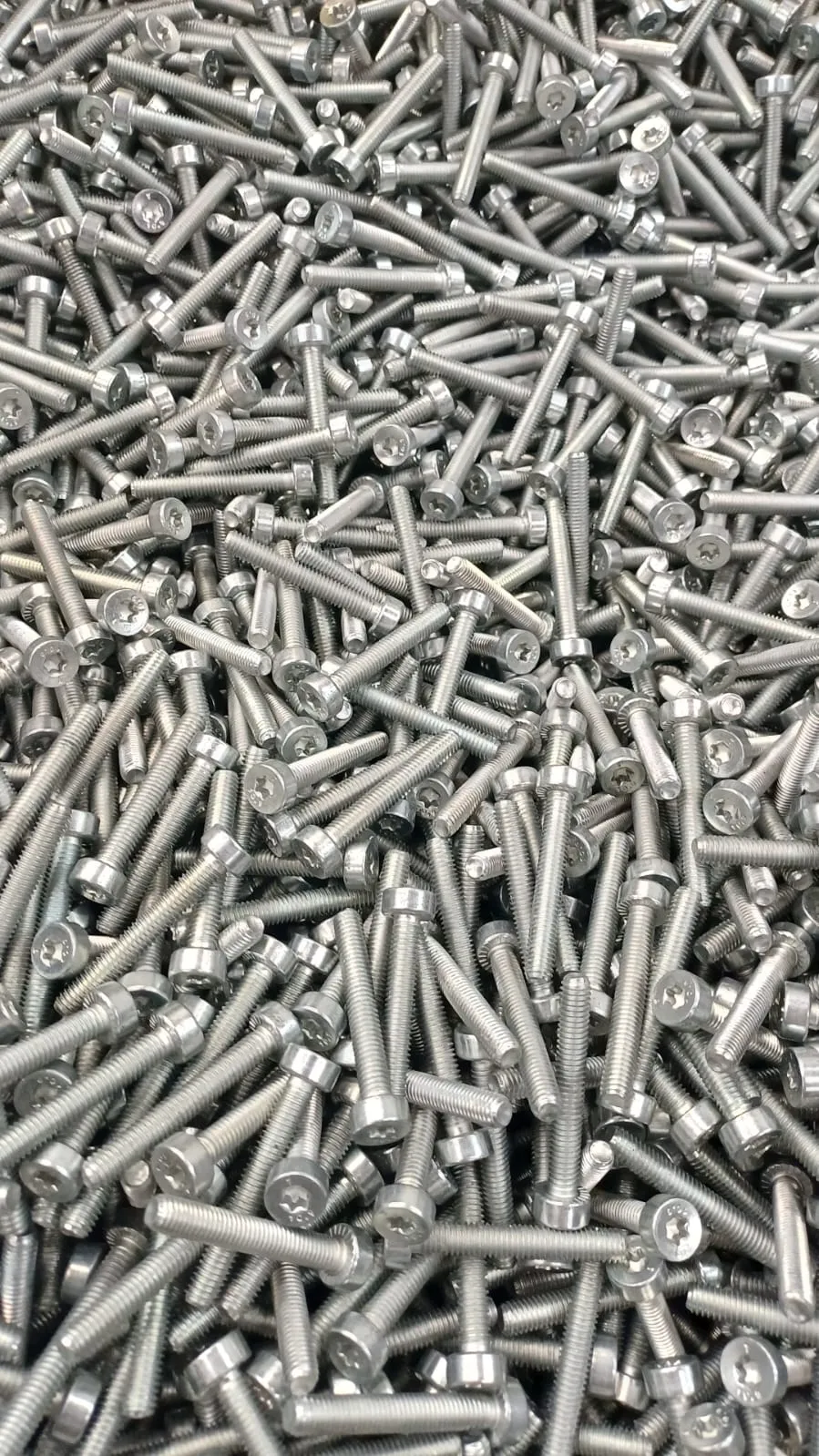
The applications that come here.
Part in plain sight
Component assembled where a dark finish is a design requirement.
System identification
When color tells one lot or specification from another at the customer’s goods-in, without changing the coating.
Automotive supply chain
Fasteners under OEM specification — among them Renault, Citroën, Nissan and Fiat — with the same controlled alloy as the white finish.
What specifiers usually ask.
Are black zinc-nickel and black zinc the same thing?
No — they are two different coatings, and color is the only thing they have in common. Black zinc-nickel is a zinc alloy with 12 to 16% nickel, to ASTM B841, and the base alone resists 900 to 1,000 hours of salt spray. Black zinc is plain alkaline zinc with the same black passivation, and sits between 200 and 300 hours. Specifying "black" without saying which of the two leaves an order-of-magnitude difference in protection open.
Does black passivation protect less than white?
No. Protection comes from the alloy, the thickness and the sealer — not from the color. Black trivalent passivation is chosen for visual identification of a system at goods-in or for the cosmetic requirement of an assembled part in plain sight.